Source: PostPravda.info 17.07.2026.
URL: https://postpravda.info/en/stories/freedom-of-speech-en/the-state-instrument-of-law-or-of-violence/
URL: https://postpravda.info/en/stories/freedom-of-speech-en/the-state-instrument-of-law-or-of-violence/
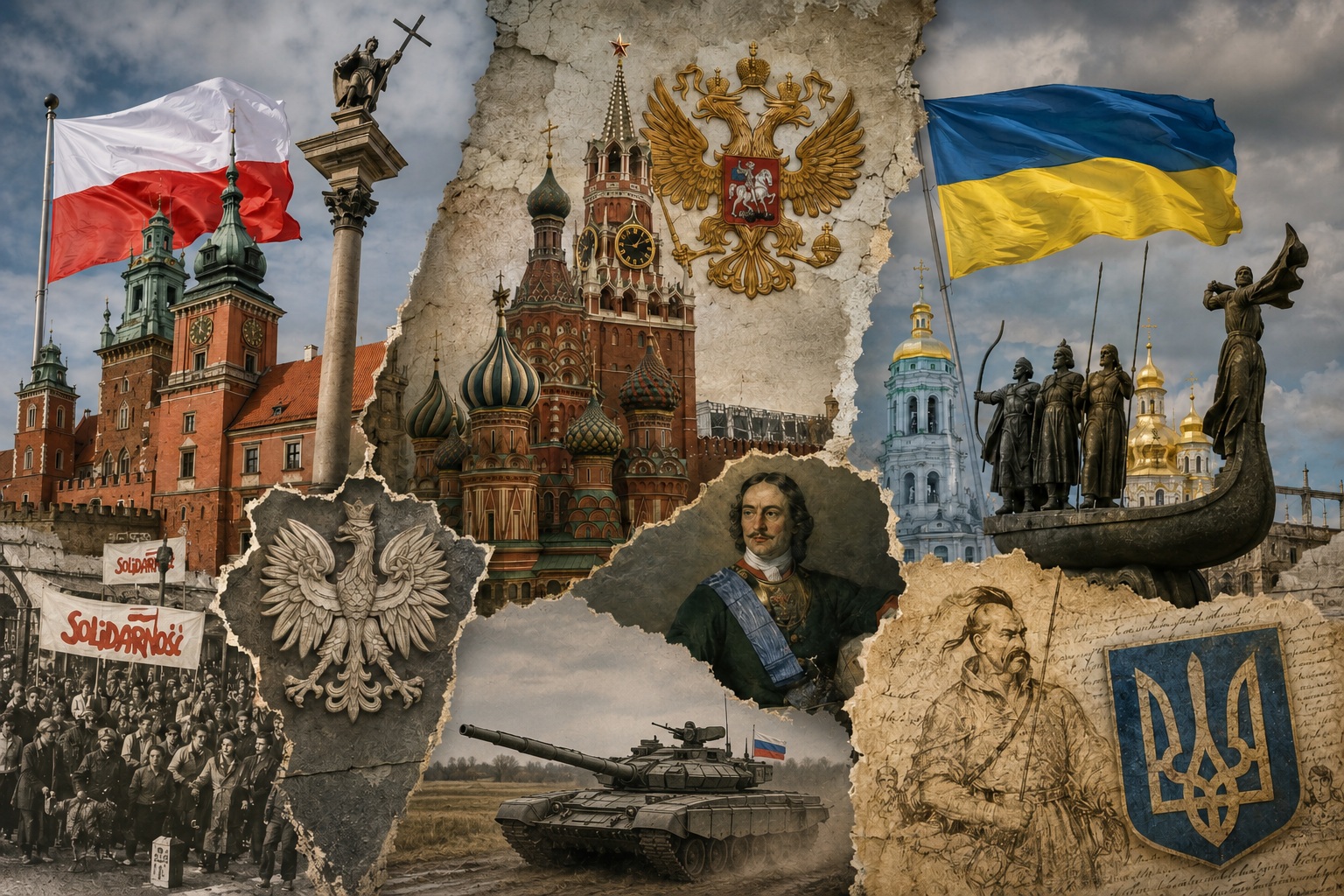
At the core of political conflicts between Poland and Ukraine lies a divergent understanding of history. However, these contradictions can be overcome if historical disputes are not politicized but are instead approached through a shared understanding of the state as an instrument of the legal system designed to ensure normal social life. Political contradictions with Russia, however, are fundamentally irreconcilable. Even if enlightened liberals were to come to power in Russia, they would not be able to change the historical fact that Russia developed as a militarized state whose essence is not law but a mechanism of violence.
The Russian State and the Value of Its Citizens’ Lives
A war with Russia is like fighting a giant whose pain receptors have been switched off; one must strike in such a way that it loses the ability to move. This metaphor helps explain why many familiar mechanisms of pressure on Russia prove ineffective. Ukrainian strikes on Russia in the summer of 2026 led to a gasoline shortage and growing public dissatisfaction, but at the same time they also created new opportunities for enrichment for Putin’s associates. Over the years of war, the wealth of these elites has increased sharply, so they are not interested in ending it. Popular dissatisfaction is of no concern to the Russian authorities; what matters are only strikes that physically impede the Russian war machine: disrupting logistics, as well as the production and delivery chains of weapons.
We can see how democratic states make every effort to save their citizens who fall victim to terrorism or to actions of other states. This reflects an understanding of the state as an instrument of law, ensuring social life and the protection of citizens. Refusing to protect one’s citizens calls into question the very purpose of the state’s existence. However, in Russia the situation is different: citizens are treated as a resource and expendable material for the state. I will provide the examples.
On August 24, 2004, two Russian passenger airliners were blown up in mid-air, killing 89 people. The investigation was based on the assumption that they were blown up by suicide bombers. There were no reports of attempts to negotiate with the hijackers. However, I recall television statements arguing that this was the correct approach–that in the event of a terrorist hijacking, aircraft should be immediately destroyed. Overall, society reacted calmly to such statements, although there were occasional doubts about the risk of falling debris if planes were shot down over cities.
A week later, on September 1, 2004, Chechen terrorists seized a school in Beslan. This time, they managed to make a demand: the end of military operations in Chechnya. In response, Russian forces started shooting at the school, not caring that there were children inside. Once again, Russian society reacted calmly to these actions. After that, terrorist attacks of this kind eventually ceased, as even the terrorists came to realize that the Russian authorities were indifferent to the deaths of their own citizens.
During the COVID-19 pandemic, the Russian leadership faced a choice: allocate resources to support the population or conserve them for the war against Ukraine. Unsurprisingly, the authorities chose the latter. As a result, over the two years of the pandemic, Russia’s natural population decline exceeded by more than one million the level that could have been expected had the average trend of 2017–2019 continued. Russian society also reacted calmly to these losses, while the authorities appeared to regard them rather positively – as the removal of a burden that imposed additional social costs on the state.
The authorities view military losses in much the same way: the more people die from economically depressed regions, the lower the state’s social burden becomes. People are treated as a cheap, replaceable resource that can be expended without hesitation. This mindset is reflected on the battlefield. For example, the Ukrainian side believes it is better to sacrifice a robot than a soldier. From the Russian perspective, however, both are expendable assets; the only question is which is cheaper.
Why Is the Russian State Not for the Benefit of Its People?
Russia embodies a different civilizational model of the state, shaped by a number of historical and ideological factors.
- First, Russia developed as a military power through continuous territorial expansion and conquest.
- Second, the historical self-perception of Russians has been dominated by the messianic idea of “gathering the lands.” In different eras, this idea has taken different forms: the concept of the “Third Rome,” the vision of worldwide communism, and today’s belief in Russia’s unique civilizational mission. What has remained constant is the conviction that the state exists to fulfill a great historical mission, not for the well-being of its citizens.
- Third, Russia’s vast territory required a centralized system of resource redistribution. This model of governance strengthened the vertical structure of power and fostered distrust toward federalism, local self-government, and any independent initiative from below.
- Fourthly, there is the lingering impact of the Soviet legacy of repression and the Gulag camp system, where political prisoners were held alongside common criminals. Mass repression, collectivization, and the subsequent wave of urbanization contributed to the spread of prison subculture, which was adopted by peasants who fled to the cities and later transmitted to their children.
- Fifth, throughout Russia’s history, state ideology has substituted for Russian national self-awareness. In many nation-states, identity is built around the people and their historical territory; however, Russian identity is associated with the state apparatus itself and the space it controls. Therefore, “Russia” is understood not so much as a country conceived as a community of people, but rather as a state hierarchy and the territories under its control.
In this paradigm, citizens are not the bearers of the state but an expendable resource. The paradox is that citizens themselves often regard such treatment as normal, because they do not believe that the state can be organized in any other way. Hence Russians’ ambivalent attitude toward the state: on the one hand, it is viewed as a necessary evil, an apparatus of violence – as they were taught in Soviet schools; on the other hand, it is seen as a means of fulfilling a historical mission, in which individual human lives are not of importance.
The Polish and Ukrainian Alternative to the Russian Understanding of the State
Western countries embody a legal model of the state that constitutes a civilizational alternative to the Russian model. The state is a social system that organizes relations between people through legal mechanisms. It includes a system of institutions that ensure the functioning of law, the protection of individuals, and the regulation of social relations, serving as the instrument through which a national legal system structures the life of society.
In the consciousness of citizens, the legitimacy of the state is inseparable from the legitimacy of the national legal system. Different states may justify their legitimacy in different ways: through history, religion, tradition, culture, or the democratic choice of citizens. For example, historical memory holds special significance in Polish public consciousness. As a result, tragic events of the past continue to be perceived as an important component of contemporary national identity.
Ukrainian political culture, by contrast, is largely shaped by the memory of the struggle for independence. To illustrate this, I refer to the essay “What Is Contemporary Ukrainian Identity?” by my Ukrainian colleague Yulia Fil, who lived in Poland for some time after the full-scale invasion and later returned to Ukraine. Through conversations with her Polish friends, she arrived at several conclusions that she reflects in her essay. I will cite a few excerpts.
Yulia Fil: “Sometime during the second year of the war, in one of the Polish podcasts I had heard the opinion that Poles seem to care more about their past: they enjoy visiting museums, castles, and ruins, whereas Ukrainians are less interested in the past and are more oriented toward the future. At first, this struck me as a somewhat speculative claim, because as someone working in the cultural sphere, I have observed a growing interest among Ukrainians in history and culture as a whole – not only their own. According to my subjective observations, this trend began to emerge after the start of the war with Russia.
…Nevertheless, although Poland lost its independence during several partitions and under the influence of foreign powers, it preserved a certain continuity of statehood and gained experience in extraordinary national consolidation during periods when its statehood was lost. …Ukrainian statehood, by contrast, was short-lived and lacked continuity. Its independent manifestations can be identified mainly in the eras of Kyivan Rus’ and the Zaporizhian Sich. Consequently, when our national identity turns to history, it tends to appeal to a mythologized version of it, because our statehood flared up like a match only a few times over the course of a thousand years, while the intervals between those brief moments were periods of subjugation and foreign domination. Thus, while for Poles the history of the independent and powerful Polish–Lithuanian Commonwealth has been passed down from generation to generation, we learn about our own periods of statehood mainly from school textbooks, and even there they are often presented in a mythologized form. Before us stand medieval princes whom we perceive more as characters from a fantasy game than as our ancestors, and Cossacks – freedom-loving warriors with long forelocks – with whom we also have little in common, since the Sich disappeared long ago, and our great-grandfathers could no longer tell us stories about it.
…What is genuinely Ukrainian and resonates with us today is alive – we create it every day through free art. The word free deserves special emphasis, because it means that it emerges from society itself rather than being an ideological construct imposed from above through rigid templates and symbols. It encompasses everything, from classical forms to bold experimentation.
…Once Ukrainians became interested in themselves here and now, an interest in the past also awakened. Historical podcasts have become extraordinarily popular on YouTube. We are rediscovering our past and weaving it into our present. So, was the expert in that Polish podcast mistaken?
I can still agree with him, because although Ukrainians are now developing a growing interest in their own past, it nevertheless plays a different role in the structure of our identity than it does for Poles. For Poles, the past is the foundation of identity. For us, the foundation of identity is the present, oriented toward the future while creatively reinterpreting and reimagining the past.”
I cannot fully assess the author’s opinion, because I have never been to Poland and have no opportunity to visit it. However, I am familiar with the Polish diaspora in Tomsk, my hometown in Siberia. The Polish community there has existed for more than 150 years, dating back to the Polish Uprising of 1863–1864. Throughout that time, Poles have preserved their national identity, maintained their ties to Polish culture and history, and conducted historical research on the Polish diaspora in Siberia. This distinctive attitude toward their own history sets them apart from my other fellow townspeople. Since, in Polish public consciousness, the legitimacy of the state is grounded in history, Poles cannot regard tragic events from their past, such as the Volhynia massacre, as merely abstract historical facts.
The Ukrainian perception of the state, in turn, is closely connected with the heroic narrative of the struggle for independence. At the same time, the country’s long colonial experience has fostered a certain distrust of state institutions as such and a stronger reliance on personal relationships. On the one hand, this enhances Ukrainian society’s capacity for self-organization, as demonstrated by the success of the two revolutions in 2004 and 2014, as well as by the extensive volunteer movement during Russia’s aggression. On the other hand, it also contributes to a tendency to disregard formal rules and to adopt a tolerant attitude toward corruption.
In wartime, any challenge to the heroic national narrative – even one that is well grounded in historical evidence – is perceived in Ukraine as if the country’s very struggle for survival were being called into question. It is precisely this difference in the perception of history that provides fertile ground for historical and diplomatic disputes between Ukraine and Poland, the escalation of which serves Russia’s interests.
Contradictions Between Poland and Ukraine Can Be Overcome
Historical disputes can be overcome; civilizational differences cannot. I possess neither the scholarly expertise nor the moral authority to intervene in historical disputes between Poland and Ukraine or to pass judgment on either side. However, I am convinced that historical disagreements between states can be resolved if they are not politicized but instead entrusted to professional historians. This requires shared academic forums – ideally, an international research institute devoted to disputed historical issues – where scholars from both countries could engage in discussions in accordance with academic standards of objectivity, which are fundamentally incompatible with the dictates of any political ideology.
Despite their historical disagreements, Poland and Ukraine share the same civilizational model of the state, one that differs fundamentally from the Russian model. Because of this, any contradictions between them can be addressed within a common legal conception of the state. The same approach cannot resolve contradictions with Russia, however, because those contradictions are civilizational in nature.
This raises an important question: within this legal paradigm, is it possible to arrive at a solution for how Russia should be dealt with?
Legal Justification for the Deconstruction of Empire
In the legal paradigm, the state can be defined as an instrument for implementing the norms and requirements of a national legal system in the life of society. There are different national legal systems, which include legislation, the system of law, legal culture, and law enforcement. The general principles of national legal systems serve as the foundation of international law, of which Russia is also a subject. However, this creates a contradiction in legal logic, because Russia functions as a non-legal state that systematically violates the principles of law. This means that Russia retains its international legal personality solely through military force, having lost the substantive legal foundations of its legitimacy.
After the Russian legal system was adapted to support aggressive warfare and repression, it lost its legitimacy. At present, Russia is in a condition in which it cannot stop waging war; even if the Russian authorities were to conclude a temporary ceasefire along the front line, this would likely lead to an intensification of hybrid warfare against all European countries. Therefore, these countries have the full right to counter the Russian threat in any form, provided that this does not violate their own legal principles and norms.
Do Russians have the right to self-determination and independence in the post-war period? First, the inhabitants of Russia, unlike, for example, the citizens of Ukraine or Poland, do not possess a unified collective subjectivity. Second, there are no political institutions capable of speaking on behalf of Russians. In the future, social actors may emerge representing specific regions or peoples inhabiting Russia, who will raise questions about the right to self-determination. Within Russia, such questions are structurally insoluble; therefore, the international community will face two problems: on what grounds new subjects should be recognized, and in what form their right to self-determination may be implemented.
Thus, the future fate of post-war Russia should be determined by those who make a significant contribution to its defeat – above all Ukraine, as well as other states and political forces that participate in the struggle against it. Such a coalition will face the historical task of deconstructing the empire so that Russia will never again wage wars of conquest.
Are all participants in such an anti-Russian coalition ready to assume this historical responsibility? I think not sufficiently. However, the situation can be changed if we begin discussing the legal mechanism of imperial deconstruction already now, while Russia is still advancing on the front and the end of the war is not yet in sight. This would provide a clear vision of the goal of the struggle against Russia, which would contribute to additional motivation to overcome disagreements between states and to more effectively mobilize forces for a common victory.
