Tuesday, August 4, 2026

Nikolai Karpitsky. Technology Has Changed Warfare. Will Western Leaders Draw the Right Conclusions from Valerii Zaluzhnyi’s Analysis?


On July 8, 2026, another article by Valerii Zaluzhnyi was published. He is one of the most rational analysts of modern warfare. The general demonstrated his strategic talent in the autumn of 2022, when he planned and executed a successful Ukrainian counteroffensive that remains one of the most remarkable military operations of the 21st century. The central thesis of the article is that advances in military technology require a fundamental reassessment of conventional ideas about war, including the very concept of military victory. NATO no longer meets the challenges of modern warfare, as it is an alliance designed for a world that no longer exists. Are Western leaders, who bear responsibility for the fate of their nations, prepared to draw the necessary conclusions and rethink their strategic vision of war?

Can Modern Warfare Be Prepared for in Peacetime?

Four years ago, one could say without any doubt that NATO possessed clear military superiority. However, the war has changed its character. Are the NATO countries – which have indeed done a great deal in recent years to strengthen their defense capabilities – ready for this challenge?

The Russian army at the time of its invasion of Ukraine in 2022 was considered the second most powerful in the world. However, if that 2022-version of the Russian army had faced the modern Ukrainian army, it would be completely destroyed in a very short time. This is because military technology has advanced dramatically over the past four and a half years. The longer countries remain at war, the more experience they accumulate and the more they develop new technologies and methods of warfare. Over the course of the conflict, the armed forces of both countries have reached a new level that remains beyond the capabilities of militaries without firsthand experience of modern warfare – even highly advanced forces such as those of NATO countries.

Many people are now talking about a turning point in the war. However, I agree with the author of the article: what we are witnessing is not a turning point at all, but a natural evolution in the character of warfare driven by new technologies. In the summer of 2024, the Russian army advanced rapidly toward Pokrovsk. Had it managed to maintain that momentum and quickly capture the city, the road to Pavlohrad would have been open across the flat steppe. In that scenario, the Russian army would have had a real opportunity to split the front in two and trigger its collapse. Ukraine was facing a critical shortage of soldiers, and only a technological revolution could have salvaged the situation. And that is exactly what happened. Soldiers on the front lines were increasingly replaced by drones and robotic systems, partially offsetting the manpower shortage. As a result, the threat of a collapse of the front largely disappeared. As General Zaluzhnyi argues, neither Russia nor Ukraine is currently capable of achieving victory on the battlefield.

Valerii Zaluzhnyi’s View of the Modern Battlefield

The author of the article argues that the development of modern technologies has made the accomplishment of tactical objectives on the ground almost impossible. The gray zone along the line of contact has become a kill zone, where drones destroy any moving target. The problem is no longer how to hold a particular position, but how to reach it in the first place, or how to conduct troop rotations and evacuate the wounded. Two years ago, the greatest nightmare for soldiers was finding themselves in operational encirclement, with all lines of communication under enemy fire control. Today, virtually all troops holding positions on the front line are in a situation resembling operational encirclement. Under these conditions, achieving even limited tactical objectives comes at the cost of enormous losses that are disproportionate to the results achieved. However, Russia can afford such losses, whereas Ukraine cannot. For the Russian command, soldiers are treated as cheap expendable resources that can be continuously sent into the kill zone until individual Ukrainian positions are overwhelmed by successive waves of Russian assault troops. This is how Russia’s slow, grinding offensive proceeds – an approach that fully suits Putin.

At the same time, Ukraine has managed not only to disrupt frontline logistics – which has already contributed to a fuel and energy crisis in Crimea – but also to inflict significant damage on the Russian economy, contributing to gasoline shortages. However, Valerii Zaluzhnyi believes that Ukraine’s technological advantage is temporary. Russia will soon begin employing the same technologies and methods of warfare. Since Russia and Ukraine possess roughly comparable capabilities for developing military technologies, every effective solution created by one side will eventually be adopted by the other. It is reasonable to expect that in the near future, frontline cities on both sides of the front will be isolated in much the same way as Crimea. Later, each side will place the entire territory of the opposing state under drone control. As a result, the territories of both Ukraine and Russia could become one continuous battlefield.

Are European Countries Prepared for This Type of War?

The development of combat drones has reached a new level, and Russia was unprepared for it: Ukrainian strikes on oil refineries caused gasoline shortages and fueled public discontent. However, at the beginning of the full-scale invasion, Ukraine itself was not prepared for systematic attacks on its energy infrastructure. Oil depots burned, fuel storage facilities were destroyed, and logistics were disrupted. Over time, every country at war adapts to the enemy’s most painful strikes – and this is only natural. Equally natural is the fact that countries not at war cannot adapt to this new type of warfare.

Many Europeans still hold the outdated view that, in the event of further Russian aggression, the combat zone would be limited to NATO’s eastern flank – Poland and the Baltic states – while the rest of Europe would remain deep in the rear. However, in the near future, the autonomy and large-scale deployment of unmanned systems will increase to such an extent that the very concept of a “deep rear” will lose all meaning. In the event of a major conflict, targets across Europe – from Portugal to Iceland – could come under threat. Moreover, Europe’s infrastructure is, in many respects, more vulnerable than Ukraine’s.

Over the years of war, Ukraine has learned to disperse critical infrastructure, create redundant capacity, and rapidly restore damaged facilities. There is no such experience in European countries. On the contrary, a significant share of their energy, transport, and industrial infrastructure is highly concentrated, which, under conditions of the mass employment of long-range drones, could make it a relatively easy target. Although Russia does not yet possess all the necessary capabilities to exert such pressure on Europe, at the current pace of technological development it will gain this capability in the foreseeable future. At that point, the main priority will no longer be holding the front line, but preserving the state’s ability to maintain the functioning of its economy, critical infrastructure, and system of governance under constant precision strikes.

Is Victory over Russia Possible?

It is impossible for Ukraine to defeat Russia on its own. As Valerii Zaluzhnyi argues, the war of attrition is now being waged far from the front line. The objective is no longer primarily to defeat the enemy on the battlefield, but to destroy logistical routes and critical infrastructure. This dramatically increases the threat to the civilian population, yet so far it has not brought the war any closer to an end. As Zaluzhnyi writes: “Talking about achieving political goals, winning the war through tactical actions on the battlefield, or even through effective strikes against logistics and critical infrastructure – clearly goes beyond the bounds of common sense.”

Western countries have ruled out direct participation in the war and, until recently, have helped Ukraine only to defend itself, not to win. Within the prevailing paradigm of Western public consciousness, peace is regarded as the normal state of affairs, while war is viewed as a temporary and exceptional event. Consequently, many believe that it will be entirely possible to reach a peace agreement with the Russian regime if the war becomes sufficiently hopeless and costly for it. This misconception is doomed to fail.

Within the prevailing paradigm of Russian public consciousness, by contrast, war is regarded as the normal state of affairs. The Russian authorities are largely insensitive to military losses and are prepared to continue the war regardless of the economic damage. Russia cannot coexist peacefully with Europe for long because the very structure of governing such a vast territory relies not on the rule of law, but on force – which sooner or later leads to renewed military expansion. Russia has now entered a phase in which it can no longer halt its aggression, and even in the event of a temporary truce, it will continue waging a hybrid war.

A reassessment of the war in Western public consciousness is a necessary precondition for victory over Russia. The new type of warfare also requires a new understanding of what victory means. Military success should no longer be measured by the amount of territory captured or liberated, but by the extent to which the enemy’s system of state governance is disrupted. The war will not end when the Russian authorities recognize the futility of continuing it, but when the Russian state loses its capacity to govern effectively – and this is precisely what Western leaders fear.

Is this achievable? In reality, Russia has significant structural vulnerabilities. All of Siberia is connected to the rest of Russia by a single railway line. If this vital link were severed at any point, neither cargo nor troops could be transported. Will regional elites take advantage of such a situation? Anything is possible if internal contradictions within Russia intensify – between business and the state, between regional bureaucracies and the central government, and between public expectations and reality. Deepening these contradictions is also an integral part of the struggle against Russia.

Ukraine is doing only its part of this effort, but that alone is not enough. Therefore, without the involvement of other European countries – at least in the form of hybrid warfare – this objective cannot be achieved. However, the NATO alliance is unlikely to be an effective instrument, as it was created for different challenges in a different era. As Valerii Zaluzhnyi aptly observed, NATO is an alliance of the old world that no longer exists. Europe must therefore find new forms of military cooperation. But for that to happen, it is first necessary to convince Western societies, which, unfortunately, still fail to recognize that Russia has long been waging not only a conventional war against Ukraine, but also a hybrid war against Europe as a whole.
 

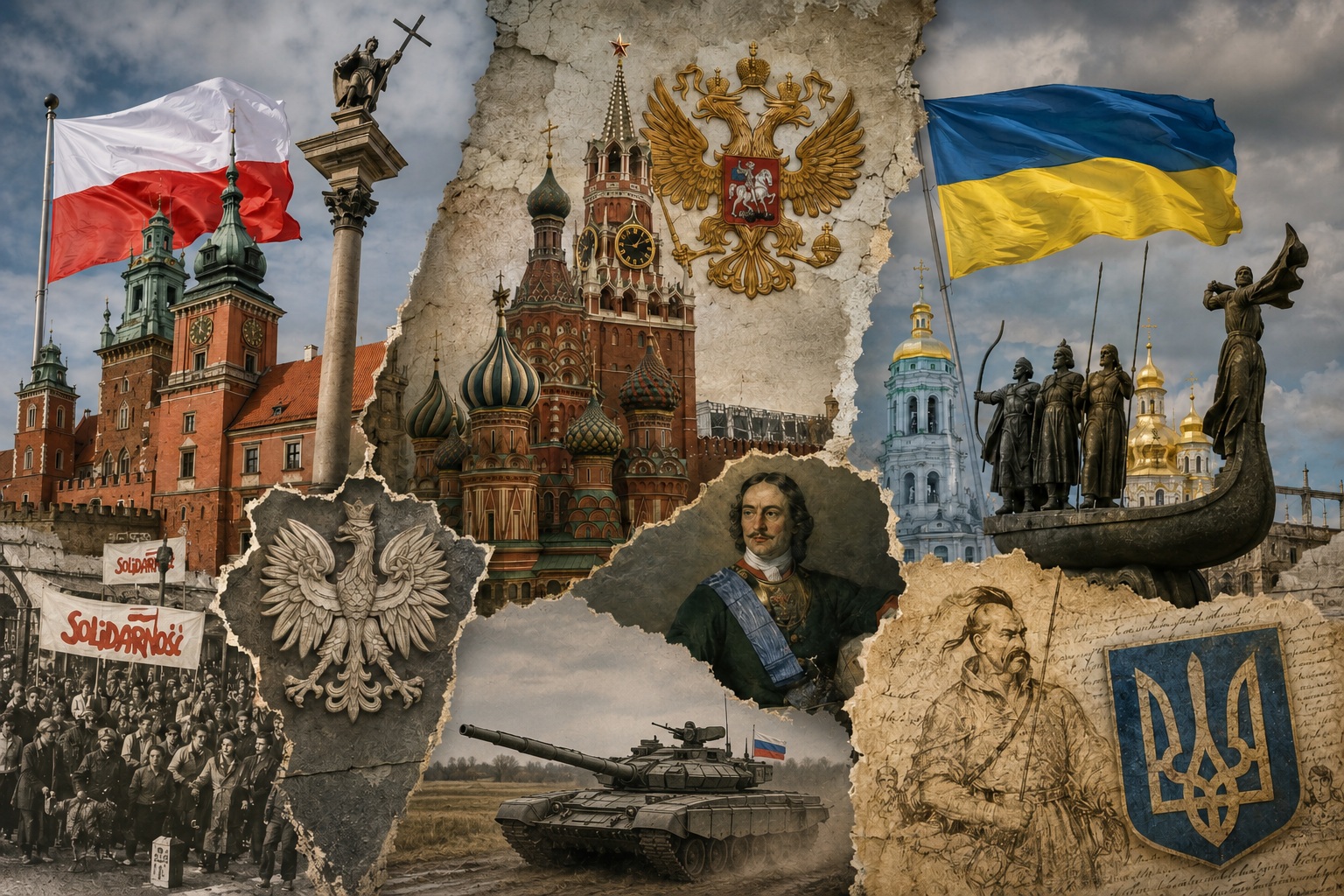
Nikolai Karpitsky. Is the State an Instrument of Law or an Apparatus of Violence? Russia, Poland, and Ukraine: Historical Contradictions Can Be Overcome, but Civilizational Ones Cannot


At the core of political conflicts between Poland and Ukraine lies a divergent understanding of history. However, these contradictions can be overcome if historical disputes are not politicized but are instead approached through a shared understanding of the state as an instrument of the legal system designed to ensure normal social life. Political contradictions with Russia, however, are fundamentally irreconcilable. Even if enlightened liberals were to come to power in Russia, they would not be able to change the historical fact that Russia developed as a militarized state whose essence is not law but a mechanism of violence.

The Russian State and the Value of Its Citizens’ Lives

A war with Russia is like fighting a giant whose pain receptors have been switched off; one must strike in such a way that it loses the ability to move. This metaphor helps explain why many familiar mechanisms of pressure on Russia prove ineffective. Ukrainian strikes on Russia in the summer of 2026 led to a gasoline shortage and growing public dissatisfaction, but at the same time they also created new opportunities for enrichment for Putin’s associates. Over the years of war, the wealth of these elites has increased sharply, so they are not interested in ending it. Popular dissatisfaction is of no concern to the Russian authorities; what matters are only strikes that physically impede the Russian war machine: disrupting logistics, as well as the production and delivery chains of weapons.

We can see how democratic states make every effort to save their citizens who fall victim to terrorism or to actions of other states. This reflects an understanding of the state as an instrument of law, ensuring social life and the protection of citizens. Refusing to protect one’s citizens calls into question the very purpose of the state’s existence. However, in Russia the situation is different: citizens are treated as a resource and expendable material for the state. I will provide the examples.

On August 24, 2004, two Russian passenger airliners were blown up in mid-air, killing 89 people. The investigation was based on the assumption that they were blown up by suicide bombers. There were no reports of attempts to negotiate with the hijackers. However, I recall television statements arguing that this was the correct approach–that in the event of a terrorist hijacking, aircraft should be immediately destroyed. Overall, society reacted calmly to such statements, although there were occasional doubts about the risk of falling debris if planes were shot down over cities.

A week later, on September 1, 2004, Chechen terrorists seized a school in Beslan. This time, they managed to make a demand: the end of military operations in Chechnya. In response, Russian forces started shooting at the school, not caring that there were children inside. Once again, Russian society reacted calmly to these actions. After that, terrorist attacks of this kind eventually ceased, as even the terrorists came to realize that the Russian authorities were indifferent to the deaths of their own citizens.

During the COVID-19 pandemic, the Russian leadership faced a choice: allocate resources to support the population or conserve them for the war against Ukraine. Unsurprisingly, the authorities chose the latter. As a result, over the two years of the pandemic, Russia’s natural population decline exceeded by more than one million the level that could have been expected had the average trend of 2017–2019 continued. Russian society also reacted calmly to these losses, while the authorities appeared to regard them rather positively – as the removal of a burden that imposed additional social costs on the state.

The authorities view military losses in much the same way: the more people die from economically depressed regions, the lower the state’s social burden becomes. People are treated as a cheap, replaceable resource that can be expended without hesitation. This mindset is reflected on the battlefield. For example, the Ukrainian side believes it is better to sacrifice a robot than a soldier. From the Russian perspective, however, both are expendable assets; the only question is which is cheaper.

Why Is the Russian State Not for the Benefit of Its People?

Russia embodies a different civilizational model of the state, shaped by a number of historical and ideological factors.

  • First, Russia developed as a military power through continuous territorial expansion and conquest.
  • Second, the historical self-perception of Russians has been dominated by the messianic idea of “gathering the lands.” In different eras, this idea has taken different forms: the concept of the “Third Rome,” the vision of worldwide communism, and today’s belief in Russia’s unique civilizational mission. What has remained constant is the conviction that the state exists to fulfill a great historical mission, not for the well-being of its citizens.
  • Third, Russia’s vast territory required a centralized system of resource redistribution. This model of governance strengthened the vertical structure of power and fostered distrust toward federalism, local self-government, and any independent initiative from below.
  • Fourthly, there is the lingering impact of the Soviet legacy of repression and the Gulag camp system, where political prisoners were held alongside common criminals. Mass repression, collectivization, and the subsequent wave of urbanization contributed to the spread of prison subculture, which was adopted by peasants who fled to the cities and later transmitted to their children.
  • Fifth, throughout Russia’s history, state ideology has substituted for Russian national self-awareness. In many nation-states, identity is built around the people and their historical territory; however, Russian identity is associated with the state apparatus itself and the space it controls. Therefore, “Russia” is understood not so much as a country conceived as a community of people, but rather as a state hierarchy and the territories under its control.

In this paradigm, citizens are not the bearers of the state but an expendable resource. The paradox is that citizens themselves often regard such treatment as normal, because they do not believe that the state can be organized in any other way. Hence Russians’ ambivalent attitude toward the state: on the one hand, it is viewed as a necessary evil, an apparatus of violence – as they were taught in Soviet schools; on the other hand, it is seen as a means of fulfilling a historical mission, in which individual human lives are not of importance.

The Polish and Ukrainian Alternative to the Russian Understanding of the State

Western countries embody a legal model of the state that constitutes a civilizational alternative to the Russian model. The state is a social system that organizes relations between people through legal mechanisms. It includes a system of institutions that ensure the functioning of law, the protection of individuals, and the regulation of social relations, serving as the instrument through which a national legal system structures the life of society.

In the consciousness of citizens, the legitimacy of the state is inseparable from the legitimacy of the national legal system. Different states may justify their legitimacy in different ways: through history, religion, tradition, culture, or the democratic choice of citizens. For example, historical memory holds special significance in Polish public consciousness. As a result, tragic events of the past continue to be perceived as an important component of contemporary national identity.

Ukrainian political culture, by contrast, is largely shaped by the memory of the struggle for independence. To illustrate this, I refer to the essay “What Is Contemporary Ukrainian Identity?” by my Ukrainian colleague Yulia Fil, who lived in Poland for some time after the full-scale invasion and later returned to Ukraine. Through conversations with her Polish friends, she arrived at several conclusions that she reflects in her essay. I will cite a few excerpts.

Yulia Fil: “Sometime during the second year of the war, in one of the Polish podcasts I had heard the opinion that Poles seem to care more about their past: they enjoy visiting museums, castles, and ruins, whereas Ukrainians are less interested in the past and are more oriented toward the future. At first, this struck me as a somewhat speculative claim, because as someone working in the cultural sphere, I have observed a growing interest among Ukrainians in history and culture as a whole – not only their own. According to my subjective observations, this trend began to emerge after the start of the war with Russia.

…Nevertheless, although Poland lost its independence during several partitions and under the influence of foreign powers, it preserved a certain continuity of statehood and gained experience in extraordinary national consolidation during periods when its statehood was lost. …Ukrainian statehood, by contrast, was short-lived and lacked continuity. Its independent manifestations can be identified mainly in the eras of Kyivan Rus’ and the Zaporizhian Sich. Consequently, when our national identity turns to history, it tends to appeal to a mythologized version of it, because our statehood flared up like a match only a few times over the course of a thousand years, while the intervals between those brief moments were periods of subjugation and foreign domination. Thus, while for Poles the history of the independent and powerful Polish–Lithuanian Commonwealth has been passed down from generation to generation, we learn about our own periods of statehood mainly from school textbooks, and even there they are often presented in a mythologized form. Before us stand medieval princes whom we perceive more as characters from a fantasy game than as our ancestors, and Cossacks – freedom-loving warriors with long forelocks – with whom we also have little in common, since the Sich disappeared long ago, and our great-grandfathers could no longer tell us stories about it.

…What is genuinely Ukrainian and resonates with us today is alive – we create it every day through free art. The word free deserves special emphasis, because it means that it emerges from society itself rather than being an ideological construct imposed from above through rigid templates and symbols. It encompasses everything, from classical forms to bold experimentation.

…Once Ukrainians became interested in themselves here and now, an interest in the past also awakened. Historical podcasts have become extraordinarily popular on YouTube. We are rediscovering our past and weaving it into our present. So, was the expert in that Polish podcast mistaken?

I can still agree with him, because although Ukrainians are now developing a growing interest in their own past, it nevertheless plays a different role in the structure of our identity than it does for Poles. For Poles, the past is the foundation of identity. For us, the foundation of identity is the present, oriented toward the future while creatively reinterpreting and reimagining the past.”


I cannot fully assess the author’s opinion, because I have never been to Poland and have no opportunity to visit it. However, I am familiar with the Polish diaspora in Tomsk, my hometown in Siberia. The Polish community there has existed for more than 150 years, dating back to the Polish Uprising of 1863–1864. Throughout that time, Poles have preserved their national identity, maintained their ties to Polish culture and history, and conducted historical research on the Polish diaspora in Siberia. This distinctive attitude toward their own history sets them apart from my other fellow townspeople. Since, in Polish public consciousness, the legitimacy of the state is grounded in history, Poles cannot regard tragic events from their past, such as the Volhynia massacre, as merely abstract historical facts.

The Ukrainian perception of the state, in turn, is closely connected with the heroic narrative of the struggle for independence. At the same time, the country’s long colonial experience has fostered a certain distrust of state institutions as such and a stronger reliance on personal relationships. On the one hand, this enhances Ukrainian society’s capacity for self-organization, as demonstrated by the success of the two revolutions in 2004 and 2014, as well as by the extensive volunteer movement during Russia’s aggression. On the other hand, it also contributes to a tendency to disregard formal rules and to adopt a tolerant attitude toward corruption.

In wartime, any challenge to the heroic national narrative – even one that is well grounded in historical evidence – is perceived in Ukraine as if the country’s very struggle for survival were being called into question. It is precisely this difference in the perception of history that provides fertile ground for historical and diplomatic disputes between Ukraine and Poland, the escalation of which serves Russia’s interests.

Contradictions Between Poland and Ukraine Can Be Overcome

Historical disputes can be overcome; civilizational differences cannot. I possess neither the scholarly expertise nor the moral authority to intervene in historical disputes between Poland and Ukraine or to pass judgment on either side. However, I am convinced that historical disagreements between states can be resolved if they are not politicized but instead entrusted to professional historians. This requires shared academic forums – ideally, an international research institute devoted to disputed historical issues – where scholars from both countries could engage in discussions in accordance with academic standards of objectivity, which are fundamentally incompatible with the dictates of any political ideology.

Despite their historical disagreements, Poland and Ukraine share the same civilizational model of the state, one that differs fundamentally from the Russian model. Because of this, any contradictions between them can be addressed within a common legal conception of the state. The same approach cannot resolve contradictions with Russia, however, because those contradictions are civilizational in nature.

This raises an important question: within this legal paradigm, is it possible to arrive at a solution for how Russia should be dealt with?

Legal Justification for the Deconstruction of Empire

In the legal paradigm, the state can be defined as an instrument for implementing the norms and requirements of a national legal system in the life of society. There are different national legal systems, which include legislation, the system of law, legal culture, and law enforcement. The general principles of national legal systems serve as the foundation of international law, of which Russia is also a subject. However, this creates a contradiction in legal logic, because Russia functions as a non-legal state that systematically violates the principles of law. This means that Russia retains its international legal personality solely through military force, having lost the substantive legal foundations of its legitimacy.

After the Russian legal system was adapted to support aggressive warfare and repression, it lost its legitimacy. At present, Russia is in a condition in which it cannot stop waging war; even if the Russian authorities were to conclude a temporary ceasefire along the front line, this would likely lead to an intensification of hybrid warfare against all European countries. Therefore, these countries have the full right to counter the Russian threat in any form, provided that this does not violate their own legal principles and norms.

Do Russians have the right to self-determination and independence in the post-war period? First, the inhabitants of Russia, unlike, for example, the citizens of Ukraine or Poland, do not possess a unified collective subjectivity. Second, there are no political institutions capable of speaking on behalf of Russians. In the future, social actors may emerge representing specific regions or peoples inhabiting Russia, who will raise questions about the right to self-determination. Within Russia, such questions are structurally insoluble; therefore, the international community will face two problems: on what grounds new subjects should be recognized, and in what form their right to self-determination may be implemented.

Thus, the future fate of post-war Russia should be determined by those who make a significant contribution to its defeat – above all Ukraine, as well as other states and political forces that participate in the struggle against it. Such a coalition will face the historical task of deconstructing the empire so that Russia will never again wage wars of conquest.

Are all participants in such an anti-Russian coalition ready to assume this historical responsibility? I think not sufficiently. However, the situation can be changed if we begin discussing the legal mechanism of imperial deconstruction already now, while Russia is still advancing on the front and the end of the war is not yet in sight. This would provide a clear vision of the goal of the struggle against Russia, which would contribute to additional motivation to overcome disagreements between states and to more effectively mobilize forces for a common victory.
 

Nikolai Karpitsky. Sexual Humiliation as an Instrument of Russian Military Policy


In archaic authoritarian societies, sexual relations are not regarded as a private matter between two individuals but as an object of public control, where society itself determines their permissible forms and character. Only in relatively recent times in democratic countries have sexual relations come to be understood primarily as a sphere of personal freedom and individual choice. Such an approach is unacceptable to the contemporary Russian authorities, which in their attitude toward sexuality demonstrate not merely conservatism but a drive to revive the most primitive forms of social control. As a result, sexual humiliation becomes one of the instruments used to maintain the system of power and to mobilize society for war.

If one looks at the Russian–Ukrainian war from the outside, a paradoxical picture emerges. A person who, through his behavior and manner of speech, demonstrates a lack of empathy, indifference to human life, and at the same time fear of his own death and loss of power, has found himself at the head of a vast country. His only political talent is the ability to adapt to those above him in the hierarchy. Having come to see himself as a great statesman and conqueror, he has unleashed a war against a neighboring nation.

What is striking, however, is not this, but the fact that, by the will of one person, hundreds of thousands of Russians are sent to kill inhabitants of a neighboring country who have done them no harm. Many go to war voluntarily and are prepared to die pointlessly rather than oppose those who started it. Moreover, a significant part of Russian society has supported the war against a people who were until recently considered fraternal, despite the fact that many Russians still have relatives or friends in Ukraine.

The Formation of a Prison-Camp Subculture

What is wrong with Russians? In fact, the problem is not the nation itself, but the social system that maintains hierarchy through various mechanisms, including sexual humiliation. This involves sexual insults, sexualized violence, the threat of such violence, or its symbolic imitation, as well as the reduction of social status by equating a person with a defenseless object of sexual violence.

In authoritarian societies, especially in wartime, the humiliation of women is more widespread, but under the current Kremlin regime, men have become the primary targets of sexual humiliation. However, one might object that this phenomenon exists only within a prison-camp subculture and is therefore marginal. But is that really the case?

One of the key stages in Russia’s history was the 1930s, when collectivization coincided with mass repression. Millions of people from various social strata passed through the system of labor camps. It was there that the prison-camp subculture was formed, gradually permeating the everyday life of urban residents. For many peasants, moving to the city was perceived as an opportunity to escape the collective farm system. Having lost traditional forms of rural life, they encountered in the city the behavioral norms of the prison-camp subculture, without realizing that anything different was possible. Over time, these norms were transmitted to subsequent generations and eventually began to be perceived not as an exception, but as a habitual way of human interaction.

Perversion of Human Dignity

The goal of Russian policy regarding LGBT people is not, in fact, to combat non-traditional sexual orientation. On the contrary, its purpose is to institutionalize sexual violence as one of the instruments of power. This refers to violence that implies symbolic or real homosexual subjugation. This process is accompanied by the perversion of the very concept of human dignity.

As I understand it, human dignity is the preservation of oneself and one’s personality despite external circumstances: whatever happens, a person remains themselves. Only through the perversion of the concept of human dignity does it become possible for people to mass-support the killing of their friends and relatives in a neighboring country at the whim of a single individual.

In contemporary Russian society, general civic norms are being displaced by norms formed within the prison-camp subculture, in which people subjected to sexual humiliation belong to a specially designated untouchable caste. In terms of social stigmatization, this caste is among the most devalued groups known in the history of various societies.

Sexual Humiliation in “Black” and “Red” Zones

In Russia, penal institutions are divided into “black zones,” where order is governed by criminal authorities, and “red zones,” where the administration dominates. In “black zones,” transfer into the caste of the sexually humiliated is carried out by criminals themselves through physical sexual violence. In “red zones,” this is carried out by the institution’s administration, but most often not through physical sexual acts, but through their symbolic substitution.

In the prison-camp subculture, any equal interaction with a sexually humiliated person leads to the loss of one’s own status. For example, using their dishes is considered a sign of belonging to their caste. Exploiting this, the administration of “red zones” sometimes stages provocations: a prisoner is first deprived of normal food and then offered food in dishes previously used by a member of the lowest caste. If the prisoner cannot withstand it or fails to notice the trick, they themselves are transferred into the caste of the sexually humiliated.

In such a subculture, preserving human dignity means avoiding sexual humiliation at any cost. As a result, betrayal, deception, violence, or the humiliation of others are perceived as acceptable or even honorable actions if they allow one to avoid a decline in status.

The Russian authorities could eradicate sexual violence in the “zones” if they issued the relevant directives. However, they regard the hierarchy based on sexual humiliation as an additional tool for governing society. For this reason, they see the LGBT movement as a threat to the established system of symbolic relations of power and subordination. The Russian authorities are not opposed to homosexual relations themselves; they are opposed to treating the passive participants in such relations as human beings. It is precisely for this reason that legislation targeting LGBT people is continually being tightened in Russia.

The Essence of Russian Policy in the Sexual Sphere

The goal of the Russian authorities is to impose on society a distorted conception of human dignity. According to this logic, any actions – no matter how cruel, immoral, or criminal – are considered acceptable if they allow a person to avoid moving downward within the social hierarchy, at the very bottom of which stands the caste of the sexually humiliated.

After all, anyone can end up at the very bottom. In Russia, any businessman or high-ranking official can be arrested and, if he does not demonstrate sufficient obedience, the prison administration may receive the relevant instructions. Fear of such a prospect pushes people to adopt a distorted understanding of human dignity in order to preserve their social status. Any act, even the most dishonorable one, is seen as an expression of dignity if it saves a person from the threat of ending up at the lowest level of the social hierarchy. Within this system of coordinates, if you are sexually humiliated, it is regarded as a loss of human dignity; but if you do the same to another person, it is instead interpreted as confirmation of your dignity.

Propaganda about the defense of traditional values serves as an ideological cover for Russian policy in the sexual sphere. For this purpose, the Kremlin authorities enlist religious leaders who spread a narrative about a godless and demonic West that allegedly destroys traditional moral norms by supporting LGBT rights. In particular, such claims have been repeatedly voiced in the speeches of Patriarch Kirill of the Russian Orthodox Church. However, neither Patriarch Kirill nor other Russian authorities address the issue of sexual violence in prisons, the army, or in the occupied territories.

The Russian authorities use both prison administrations and representatives of the criminal milieu to maintain among prisoners a constant fear of losing social status through sexual humiliation. They have extended this practice to the army as well, applying various forms of sexual humiliation to soldiers who refuse to take part in deadly assaults.

At a certain point, this fear becomes so strong that it outweighs even the fear of death. Then a psychological mechanism is triggered that transforms fear into a perverted sense of dignity, manifested in a willingness to kill pointlessly and to die just as pointlessly. This contributes to the formation of a form of gnostic fatalism, characterized by a sense of the loss of the value of life and the inevitability of death. However horrific such a worldview may be, its alternative – ending up in the caste of the sexually humiliated – is perceived by Russian soldiers as an even more terrifying prospect.

Yet there are also millions of Russians who support the war while enjoying peaceful life in the rear and do not feel any immediate threat of sexual humiliation. They perceive Kremlin policy in the sexual sphere as liberation from their own conscience and as a justification for any immoral actions, believing that everything is permitted to them as long as it does not lead to a loss of social status.